Monday, August 17, 2009

The 6th E of leadership?


I've been thinking recently about leadership, success, and my current standing in life. What do I need to do to get myself to the next level? How do I improve myself, as a leader, as a person? You'll probably see more blog entries around this theme, but for the time being, this entry will talk about leadership, particularly the 5 Es of leadership.

The 5 Es of leadership is a leadership framework used in places like P&G. Jack Welch has his 4 Es, but I won't talk about that.

In a nutshell, the 5 Es are (lifted from this source):
ENVISION - This generally means creating a future for your organization, setting the direction for everyone to follow.
ENGAGE - Building relationships and collaborating with others inside or outside your team would fall under this E.
ENERGIZE - Energizing is inspiring your team and creating a positive climate for everyone to work in.
ENABLE - Building capability in the team to better equip them for success. This may also mean organizing everyone into a tight-knit group.
EXECUTE - This means operating with excellence, and delivering breakthrough results. All the preceding 4 Es boil down to execution.

You can refer to this site for more information, or do a Google search.
Read more.

The Black Button - short film, highly recommended

Amazing short film shared to me by Paul Garilao, a video entitled "The Black Button." I won't spoil the details, but I agree with Paul's description that this can be a good way to describe salvation (the Biblical one).

Friday, August 14, 2009

Google Wave - a few thoughts

I haven't had the chance to try out Google Wave for myself yet, so let me instead share the thoughts of a blogger I am beginning to like - Anil Dash.

The post from Anil primarily talks about what he perceives as the technological barriers to adopting Google Wave - if you're into programming, you'll love the writing. My concern is a little simpler: Google Wave is a paradigm shift in terms of online communication. Even if the technology and infrastructure is ready, if users don't find good reason to replace their current suite of communication tools with Wave then it is as good as dead. Is it easy to understand and use? Will it replace the current suite of communication tools? Are users ready?

Most probably, what will happen is Wave becomes just another communication tool, along with email, IM, and stuff like sharepoint. -> This will add complexity to an overly complex (work) life. It'll take I think about 5 years for fullscale adoption (if it ain't dead yet), because it is a very big step change. Anil actually talks more about this, below:

(BTW: It may look like I'm a Wave hater, but I really love the potential of Google Wave.)

What Works: The Web Way vs. The Wave Way

Google Wave is an impressive set of technologies, the kind of stunningly slick application that literally makes developers stand up and cheer. I've played with the Google Wave test sandbox a bit, and while it's definitely too complex to live up to the "this will replace email!" hype that greeted its launch, it certainly has some cool features. So the big question is whether Wave will succeed as overall in becoming a popular standard for communications on the web, because Google has made an admirable investment in documenting the underlying platform and making it open enough for others to build on and extend. I think the answer is no, and the reason is because the Wave way is not compatible with the Web way.

What do I mean by "the Web way"? Well, if we look at the history of new technologies being adopted to extend web sites and enhance communications, we see a few trends emerge:

  • Upgrades to the web are incremental. Instead of requiring a complete overhaul of your technical infrastructure, or radical changes to existing behaviors, the web tech that wins is usually the sort of thing that can be adopted piecemeal, integrated as needed or as a normal part of updating one's websites or applications.
  • Understanding new tech needs to be a weekend-sized problem. For a lot of web developers, long before they start integrating a new protocol or platform into their work, they hack together a rough demo over a long weekend to make sure they truly grasp how it works. And a weekend-scale implementation on a personal site usually translates roughly into a 90-day implementation cycle in a business context, which is a reasonably approachable project size. (In tech, three days in personal effort often translates to three months of corporate effort.)
  • There has to be value before everybody has upgraded. This is basically a corollary to Metcalfe's Law. While we know networks increase in value as they add more nodes, the nature of web tech is that, in order to be worthwhile, it has to provide value even if the people on the other end haven't upgraded their software or web browsers or clients or servers. Otherwise you're shouting into an empty room.
  • You have to be able to understand and explain it. Duh.

Now, if we take a look at some examples of what has worked, we can see how various successful technologies have displayed these traits. One great example is feeds. When RSS feeds were new, it was easy to understand their potential immediately, and since I was working at a newspaper at the time, I just spent an afternoon understanding the format and hacking together a quick feed of headlines that anybody could subscribe to. If nobody had adopted feedreaders yet, that was no problem, since there was no cost to just having the feed sit there with no subscribers — the "nobody's upgraded" problem would only result in me having wasted a few hours.

Ajax had a similar adoption pattern. It took a little bit more time to comprehend, but not much more than an afternoon, and the development effort required for adding Ajax enhancements to an application started as a weekend-scale project and has only gone down over time. Following the principles of progressive enhancement, well-designed implementations performed just fine on older browsers or systems that couldn't handle the new features. And most sites that have added Ajax features have done so by adding the requirements as a checklist item in the course of normal ongoing updates, not as standalone efforts to migrate to a new technology.

This brings us to Wave. Wave offers excellent opportunities to extend its core features and to add richness to its "wavelets", and I have no criticisms over its utility as a developer platform that third parties can build upon. But the fundamental Wave protocols are, I fear, a bit too complex to ever be fully and correctly implemented by anyone other than Google. Interoperability is likely to be a challenge that plagues the platform for its entire existence. In short: It's likely that nobody will ever build a fully-compatible clone of Wave that competes with Google's own implementation.

Why is that true? Let's look at what's built in to Wave:

  • Powerful realtime collaboration features
  • Unlimited versioning of content
  • Built around robust XMPP protocol
  • Combines chat, document editing, and message threading — wikis + blogs + comments + IM
  • Delivered as a very polished rich user interface

Each of these is a very compelling experience. But a lot of developers' reactions to seeing them was not just "I can't wait to use that!" but also "I want to add that one feature to my own existing application!". And that's where it gets tough. Let's take a look at Joe Gregorio's list of the protocols that power Wave. (Joe works at Google, but made this list before he was working on Wave. I appreciate his research and openness on this topic, and presenting his work here is a tribute to what makes Wave great, not a criticism of his effort.)

  • Federation (XMPP)
  • The robot protocol (JSONRPC)
  • The gadget API (OpenSocial)
  • The wave embed API (Javascript)
  • The client-server protocol (As defined by GWT)

That's a lotta stuff! XMPP alone is a bear to implement, let alone to deploy at large scale. (I can't think of anyone outside of Google, Earthlink and LiveJournal who have deployed XMPP to millions of users.) But if you wanted to make another application that truly interoperates with all that Wave can do, combining all of these pieces would just be the starting point.

And people aren't looking for a replacement for email, or instant messaging, or blogs, or wikis. Those tools all work great for their intended purposes, and whatever technology augments them will likely offer a different combination of persistence and immediacy than those systems. Right now, Wave evokes all of them without being its own distinctive thing. Which means it's most useful in providing reference implementations of particular new features.

If a developer wants one of the compelling individual features of Wave, like near-realtime collaboration, they're more likely to use something like (wait for it...)Pushbutton technologies. The infrastructure afforded by the components of the Pushbutton Platform comes nowhere near the richness and polish displayed by Google Wave. Pushbutton isn't even designed to offer the benefits demonstrated by Wave. But to its credit, Pushbutton displays nowhere near the complexity of Wave in its interoperability requirements. More importantly, integrating Pushbutton features into a website or application isn't a monolithic process of building dozens of cutting-edge features, but rather can be deployed incrementally by even non-expert webmasters.

In this context, it might help to think of Pushbutton tech as a "micro-Wave". As Gina Trapani said in mentioning Google Reader's support for PubSubHubBub:

Huh-wha? you ask. Yeah, I know. It's no Google Wave. But that's what makes this exciting. This kind of small Pushbutton implementation is how real web pages will easily use existing technology to notify one another of new updates. The Google Reader/FriendFeed integration is just the first tiny step in what will be a broad deployment of realtime-enabled sites. These sites and services will let one another know when they have new data to share without the sucky inefficiencies of polling. Check out how fast FriendFeed updates when you share an item in Google Reader in the video above.

In short, it's almost zero latency.

Why is this clearly "inferior" technology going to win? Well, as just one example,XMPP is way too complicated for any normal human to deploy. Whereas if you're reading this, you probably already have access to a regular HTTP web server that could talk to a Pushbutton hub. In fact, the only two backers I know who haveworked extensively with XMPP are Brad Fitzpatrick and Artur Bergman, who co-created Djabberd. And they are both excited about PubSubHubBub. Realistically, someone like Yahoo might try to do all of this, and inevitably one or two open source projects will try to lash together open implementations of each of these pieces to make a kind of FrankenWave application. There are probably already one or two teams working on the inevitable "Enterprise Wave Server" platforms as well, though I haven't heard about them myself. These efforts may succeed, but that doesn't mean they'll ever be robust enough that people will trust them for communicating on the web.

More to the point, I'm a regular blogger who knows a little bit about scripting on a normal web server. I can poke around the documentation and add a few tweaks to my RSS feed (or, in my case, do nothing and have Feedburner automatically handle it for me), and all of a sudden my blog's feed is part of the Pushbutton web, ready for others to build on. I literally wouldn't even know where to start with the Wave developer documentation if I wanted to integrate it with my site or any of the little apps I like to hack on during a long weekend. What seems more realistic — that someone will figure out a way to incrementally build on top of realtime feeds to enable Wave-like experiences, or that all this talk of Waves, wavelets and blips is going to suddenly become easy to understand.

In short, web-way tech like feeds, Ajax and Pushbutton win because people who make good sites and applications have a place to start with it. Does this mean we get fancy realtime simultaneous editing right away, now that Pushbutton exists? Nope. In fact, Wave might even get the early jump on those kinds of features for web apps, simply because it's pioneered that part of the user experience. But Wave only runs to its full potential on the most cutting-edge web browsers. And there may only be a dozen companies in the world with the in-house expertise to clone the entire complement of technologies underlying Wave in order to make a full-fledged competitor. Worse, the monolithic nature of the Wave experience means it will even be a challenge to make a full-fledged open source competitor to the official Google service.

I hope that Wave succeeds, because I love to see ambition and innovation rewarded. But I think it's mostly likely that Wave's success will be in inspiring people to create similarly compelling experiences by adding incremental enhancements to their existing sites. That's how the web's always advanced in the past.


Thursday, August 13, 2009

Hwang Mi Hee is Optimus Prime!

Cute Korean model Hwang Mi Hee is Optimus Prime! via Reallycuteasians.


If you like Hwang Mi Hee, vote for HMH in this poll.

Monday, August 10, 2009

Thursday, August 6, 2009

Little Prince + Deep Impact = XKCD

Yet another masterpiece from Randall Munroe. :)

Wanna listen to Randall talk @ Google? Go here.

Monday, July 20, 2009

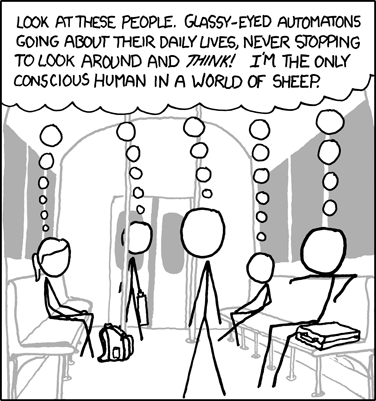
"Sheeple"

Very often I think/talk silently to myself while in public transit. Lately I even developed a habit of bringing along a small tickler notebook to record my thoughts when I'm in the jeepney, train, bus, or wherever I may be.

During situations like these, I sometimes think that the people around me are like automatons going about their daily lives like a routine that never tires. It didn't occur to me that people may think that about me too, as they see me deep in thought sometimes. This cartoon sums it up nicely.

(What are the stuff I'm thinking about? They circulate mostly around the personal site I'm trying to launch.)


More on this soon.

Saturday, July 18, 2009

Chuck Norris vs Manny Pacquiao vs Park Jung Suk

This is a poll to determine who is the toughest: Chuck Norris - martial artist/killer/supersoldier extraordinaire, Manny Pacquiao - the #1 pound-for-pound boxer in the world according to Ring Magazine, and Park Jung Suk (aka [Oops]Reach) - a Protoss Starcraft progamer for the Korean Airforce team who is "often noted for his extreme manliness" and to whom CholeraSC attributes many manly achievements to.

Google is afraid of Chuck Norris, boxers are afraid of Manny Pacquiao, and Park Jung Suk (aka [Oops]Reach) has been busy catching Nokor nuke missiles for the world.

But who is the manliest of them all?

Thursday, July 16, 2009

Saturated fat, cholesterol and a change in habit...

I recently took a company-sponsored physical examination to see where I am in terms of my health. The results surprised me a bit, let me explain.

I've been generally healthy since childhood, and I don't eat a lot of fatty foods. I rarely drink alcohol, and I don't smoke. I'm a thin person (5'10.5", ~145 lbs) and I find it extremely difficult to gain body mass.

Fatty Numbers
My doctor told me that I have high amounts of triglycerides. My reading's 201 mg/dL, just above the normal 30-200 mg/dL limit. According to wikipedia, it is the main constituent of vegetable oil and animal fats, and high levels are normally linked to heart disease.

I also had high readings of VLDL cholesterol. Like triglycerides, VLDL accelerates the risk of heart disease like atherosclerosis. I got 40 mg/dL, and normal is 0-35 mg/dL.

Retrospection
The doctor said that these numbers are associated with ingesting fat. I was quite surprised to hear these numbers, as I don't eat fatty foods in general. In fact, my mom meticulously drains out the oil in the food our family eats. The doctor said it could be because of genes, but I don't think my family has this disease in our lineage.

So I went back home and tried to observe the food I normally eat. One day when I was eating biscuits (I love biscuits, my mom makes sure we always have biscuits at home to eat as snacks, I eat quite a lot per week.) I took a look at its label. We have Monde's Bread Stix at that moment.
What I found? Bread Stix has a very high amount of saturated fat - 23% of the recommended daily allowance (based on a 2000 calorie diet)

I went to the supermarket and checked out various other cookie/biscuit brands. Except a few, they all have extremely high saturated fat amounts.

So what's saturated fat?
I did some research, and found a great resource in this NY Times article. According to that article, saturated fat is "the biggest dietary cause of high LDL levels ("bad cholesterol"). When looking at a food label, pay very close attention to the percentage of saturated fat and avoid or limit any foods that are high. Saturated fat should be limited to 10% of calories. Saturated fats are found in animal products such as butter, cheese, whole milk, ice cream, cream, and fatty meats. They are also found in some vegetable oils -- coconut, palm, and palm kernel oils. (Note: Most other vegetable oils contain unsaturated fat and are healthy.)"

Eating too much saturated fat, NY Times shares, heightens the risk of heart disease. Saturated fat leads to the buildup of cholesterol in the arteries (or atherosclerosis).

Reducing daily fat intake helps reduce the risk factors.

Change in habits...
Right now, I'm doing my best to avoid biscuits. I'll know soon if my VLDL and Triglyceride numbers decrease.

And from another POV, we're saving a bit more money because we no longer buy biscuits. :)

I'm wondering now - is it safe for kids to eat stuff like this?

Web page screen grab/capture tools

Have you ever experienced having to grab/capture an entire web page into an image file, but found it difficult because the page spans more than your computer's monitor with tools like zapgrab or print-screen?

If you have had that dilemma, here are 2 nifty tools that can help you.

The first one requires that you have Firefox installed as your web browser instead of the standard IE. The add-on that does the magic for you is called Screengrab, downloadable at the Mozilla add-ons site, here. It's extremely easy to use. Once you've installed the add-on, you'll see the screengrab icon at the lower right of your Firefox window. Go to the page you want to screengrab, click the icon, and click either save or copy.

The second one is a free online tool called Aviary. How you use this tool is just simply go to: http://aviary.com/<>. Even more so, you can also do basic image editing on this tool! So if you want to grab and edit twitter.com, just go to aviary.com/twitter.com. And oh - Aviary is also available as a Firefox add-on.

Hope these can help you!

Wednesday, July 15, 2009

Google's Microsoft moment

Very insightful blog entry by Anil Dash, on Google finally having their "Microsoft moment" when they announced Chrome OS.

What's the Microsoft moment? Simply put, this is the inflection point from "Google being the upstart" to "Google being the old, big company." With this change, company culture changes, and as Anil said, the reasons for innovating at Google also changes.

I'm going to post his entire blog here, because I think it's worth the read.

I'm not sure Google's new Chrome OS announcement is that big a deal, or that the eventual product that gets released will actually have that much impact, but it's a useful milestone in marking Google's evolution towards becoming an older company with a distinctly different culture than they used to have.

This is, for lack of a better term, Google's "Microsoft Moment". This is the point when the difference between their internal conception of the company starts to diverge just a bit too far from the public perception of the company, and even starts to diverge from reality. At this inflection point, the reasons for doing new things at Google start to change.

Let me be clear: I don't think Google is "turning evil". Hell, I've caught a lot of flack for the fact that basically I don't think Microsoft was evil. But there are some notable trends going on across Google today that could cause the company to compromise its stated values and that will certainly cause people to think Google is being evil, if not corrected. I'll try to outline a few key cultural indicators from around Google.

Designing for corporate synergy, not for users

Google's recent development work on applications for mobile devices has often been delivered exclusively as applications for their own Android platform instead of as iPhone applications, despite the fact that iPhones are roughly forty times more popular in the marketplace. iPhones are also much more popular outside of the United States than Android, further limiting the actual audience served by these applications. Now, it's obviously good company policy to make sure to support Google's own platforms, and Google does an admirable job of using generic open web technologies where possible to avoid having to choose between platforms at all. But choosing to leave the majority of users in a given market unaddressed because they are on a platform that is not part of your corporate goals is short-sighted and leaves a lingering sense of mistrust.

If you look at Microsoft ten years ago, or even as recently as five years ago, they had a tendency to say "Well, we've got a version that works on Windows Mobile." or "This works on Internet Explorer" and feel that they'd done their job for addressing mobile or the web. Or Windows Media Player would connect to XBox but not to any other systems for sharing media. They were putting their corporate agenda ahead of what the marketplace had chosen as its preferred platforms. But after all these years, Microsoft's internal teams have finally started to develop their web or mobile versions of products to work on competitor's browsers and competitor's mobile platforms, recognizing that they have to go where the users are, instead of favoring only the platforms created by their corporate siblings. Google appears to be headed the other way.

Forgetting what the real world uses, and favoring what's convenient for your own business goals is a quick way to have customers think you don't care, and to indicate to partners or developers that pleasing Google is more important than pleasing customers.

Multiple competing product lines: Chrome OS and Android

This is one of the simplest and most obvious examples, after this week's announcements: Google is now offering not one, but two mobile operating systems. While they undoubtedly share code, I can't help but think back to ten years ago, when Microsoft was vehemently protesting about how much code was shared between the Windows NT/Windows 2000 operating systems and the Windows 95/98/ME operating systems. If I make a screen two inches smaller, should I use Android instead of Chrome OS? If the keyboard works with my fingers instead of my thumbs, I should use Chrome OS and not Android? I know Google is convinced its employees are smarter than everyone else in the world, but this is a product management problem, not a computer science problem.

Changing methods of communication

Within Google, I'm sure the perception is that their public-facing communications are still very "Googley". Now, Google does an excellent job of maintaining and using an enormous number of official corporate blogs in dozens of languages for a rapidly-blossoming number of products and initiatives. But despite my admiration for that effort, and their commendable willingness to forgo the usual boring press releases, the way that the company communicates with the public has fundamentally changed, and not necessarily in a more human direction.

In lieu of blog posts or simple word-of-mouth, as helped popularize the Google search engine itself ten years ago, efforts like Chrome are being accompanied by television ads, complete with all of the production values of primetime TV. Instead of launching a new developer initiative by promoting an SDK on their blog, Google is filling convention centers, Apple-style, with day-long developer presentations and an Oprahesque giveaway of free phones under every seat. Instead of white papers, there are highly-produced comic books being distributed to the press to explain the value of Chrome.

Now, I actually support these types of outreach. Getting outside of the insular tech bubble requires higher production values and clearer messaging. But when Google evokes Apple or Microsoft or Oracle in its style of communicating ideas, and when cell phone ads on TV say "Powered by Google", an average consumer's conception of Google essentially shifts to seeing this company not as "those guys who do the search engine" but instead as another consumer electronics company, like Samsung or Sony, but a little more hip.

This would be okay, except that I doubt Google's internal self-image as an organization has changed to reflect this new reality. "We're not like some giant company with flashy TV ads — we're just a bunch of geeks in Mountain View!" And while that might be true for the vast number of engineers who define the company's internal culture, the external impression of Google being just another tech titan like Microsoft will gain footing, making the audience for Google's messages less tolerant of ambiguity and less forgiving of mistakes.

Only the last generation of companies can be evil, not us!

Though it's almost impossible to picture now, in the era when Microsoft was formed, IBM was synonymous with an almost Orwellian dominance of information technology. It's been a full 40 years since the antitrust actions against IBM, and IBM is seen as a bastion of open-sourceness now, but Microsoft's founding mindset clearly was shaped with the idea that "those old guys from the last generation are evil, and we're the nimble, smart upstarts who are going to humanize this industry". Sound familiar?

Though it's hard to believe, the FTC's first investigations against Microsoft began eighteen years ago. When Microsoft reached its apex in terms of public perception and industry respect, with the launch of Windows 95, the culture inside the company still largely saw themselves as upstarts against old, proprietary behemoths. Though Microsoft's headcount has increase fivefold since then, at the time of Windows 95's launch, they had about 17,000 employees.

Google's headcount just passed roughly 20,000 employees. And most of those staff members are firmly convinced that evil, or at least incompetence, is firmly the trait of the last generation's dominant tech player: Microsoft. The idea that developers or customers might start to bristle at their dominance is met with the (true, yet irrelevant) argument about how open their data and platforms are. Eric Schmidt said yesterday that Chrome OS is so open that Microsoft could make Internet Explorer for it, though of course the effort of porting the browser would be prohibitively complex. By neatly inverting the framing of the conversation ("We didn't bundle a browser with our OS, we bundled an OS with our browser!"), Google's avoided having to confront the parallels between this moment in their corporate culture and Microsoft's similar moment of ascendancy 15 years ago.

Still haven't developed Theory of Mind

And finally, as I outlined two years ago, Google still hasn't developed theory of mind. From my piece then:

This shortcoming exists at a deep cultural level within the organization, and it keeps manifesting itself in the decisions that the company makes about its products and services. The flaw is one that is perpetuated by insularity, and will only be remedied by becoming more open to outside ideas and more aware of how people outside the company think, work and live.

Worse, because most of the dedicated detractors of Google have been either competing companies or nutjobs, it's been hard for Googlers to take criticisms seriously. That makes it easy to have defensiveness or dismissal of criticisms become a default response.

Conclusion

Google has made commendable steps towards communicating with those outside of its sphere of influence in the tech world. But the messages will be incomplete or insufficient as long as Google doesn't truly internalize and accept that its public perception is about to change radically. The era of Google as a trusted, "non-evil" startup whose actions are automatically assumed to be benevolent is over.

Years ago, GMail introduced context-sensitive ads and was unfairly pilloried for being anti-privacy or intrusive. And while there have been a few similar hand-slappings along the way, Google's never faced a widespread backlash against their influence or dominance from average consumers yet. Today, protestations of "but it's open source!" are being used to paper over real concerns about data ownership, and the truth is that open code doesn't necessarily imply that average users are in control.

And ultimately, once a tech company becomes dominant in its space, it's susceptible to a kind of reverse Hanlon's razor: Anything caused by stupidity or carelessness will instead be attributed to malice. Similar to the Law of Fail ("Once a web community has decided to dislike an idea, the conversation will shift from criticizing the idea to become a competition about who can be most scathing in their condemnation."), Google is entering the moment where it has to be over-careful not to offend, and extremely attentive to whether they are treading lightly.

Is Google evil? It doesn't matter. They've reached the point of corporate ambition and changing corporate culture that means they're going to be perceived as if they are. Whether they're able to truly internalize that lesson, accept it, and act accordingly will determine if they're able to extend their dominance in the years to come.

Saturday, July 11, 2009

Ayumi Uehara - cool Japanese model

I've recently come across this pretty Japanese model Ayumi Uehara.

According to Japan Sugoi, Ayumi Uehara 上原歩 is a pretty 27 year old fashion model and actress from Tokyo. She started acting in 2000 and has since appeared on 12 TV shows and is currently appearing in TV Asahi’s Eazy Sports and Otome音女 .

Despite her TV appearances, she has really been more popular as a fashion model regularly appearing in magazines such as S Cawaii and Puckish. She’s also modeled for lingerie maker Ravijour, MTV Pinks, Kobe Collection 2008 Autumn/Winter and appeared on MTV Japan and girlswalker’s Girls Collection vol1 and vol2.

Update: A lot of high res pics are here. Just scroll down the page to see more photo sets.

Some sample pics below.


Sunday, July 5, 2009

How to embed flash/SWF files in blogspot/blogger

While creating my last post (engaging and funny Pringles ad! - must see), I faced an issue of how to embed flash files properly in blogspot. The menu buttons when you create your blog post only support image or video, but it is not impossible to embed flash files.

Two easy steps to embed flash (SWF files):
1. Host your SWF files somewhere - I uploaded mine in Google Pages.Take note of the URL of your SWF file. You'll need it. (As example, mine is at http://donelle.gan.googlepages.com/blankCanBeBlank.swf)

2. Edit the HTML in your blog to embed - You'll see that right to the left of Compose, there's an "Edit Html" tab. Click that and put the following code:

Change the URL to your own SWF file location, and change the width and height as needed.

That's it!

Saturday, July 4, 2009

Funny Pringles can ad - Comedy!

This is one of the funniest and most ingenious banner ads to ever grace the internet! And it's done by no other than Pringles! Play with the ad to see why.

Mybrute - weak brutes running list (part 3 of more to come)

Mybrute weak brutes list, part 3! Here are more weak brutes for you to level up easier. Majority of these are level 11 brutes. BTW - thanks to the people who viewed and commented on the first two parts so far!

1. Dadwada - Lvl 11 (has 1 dog)

2. fouros - Lvl 11

3. justdoneit - Lvl 12 (has 1 dog)

4. Pannus - Lvl 11 (has 1 dog)

5. Morkern - Lvl 7

6. Vale.mg23 - Lvl 7